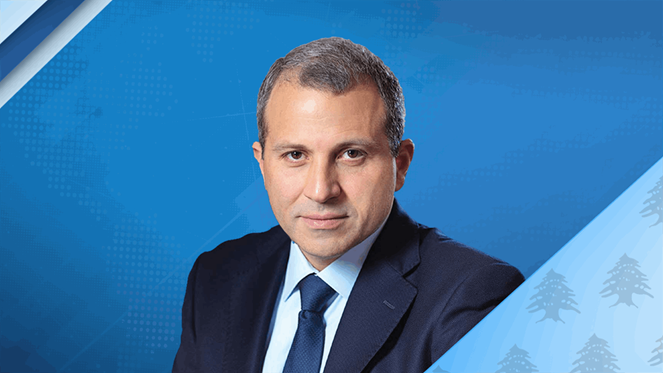
Head of the Free Patriotic Movement (FPM), MP Gebran Bassil, said that some people still cling to the idea of merging Lebanon with Syria by promoting the notion of a single civilization and a single people. This mindset, he argued, has appeared throughout Syrian history as a dream or political ambition to bring Lebanon under Syrian control, which some Lebanese also find appealing.
Speaking on Russia Today’s “Newsmaker” program, Bassil recalled that in 1976, Hafez al-Assad promoted the slogan “one people in two states.” A year after the regime’s fall, another slogan appeared: “one people, one state.” This is why Bassil reaffirmed that Lebanon and Syria are “two peoples in two states,” each with its own national identity and sovereign authority.
Bassil warned that the events of the past two days were “extremely dangerous,” referring to the large gathering of displaced Syrians who, he said, were mobilized in a way that nearly triggered sectarian tension. He questioned the government’s silence and called on it to take immediate, serious measures to return displaced Syrians, noting that current efforts fall far short.
“We were founded on freedom, sovereignty, and independence, and we cannot accept talks of annexing Lebanon to Syria, whether it comes from the U.S., European countries, Arab countries, Syria, or Lebanon itself,” he said.
He accused the Lebanese authorities of showing weakness in their dealings with Damascus, saying they have been “submissive, negligent, and acting from a place of inferiority.” Even agreeing to negotiate over the return of Syrian prisoners, he argued, is a concession: those convicted of crimes that allow for their repatriation should be sent back without negotiating. Those who have killed, kidnapped, or attacked the Lebanese Army, he said, must not be part of any deal.
South Lebanon and the Weapons Issue
Turning to the south, Bassil stated that Hezbollah must admit it can no longer claim to protect Lebanon as it once did. The old deterrence strategy, he emphasized, no longer holds. At best, he said, Lebanon can now only fend off a limited ground attack. Nonetheless, he highlighted his respect for the martyrs, the bravery of the fighters, and the sacrifices made by the residents of the south. “But at the end of the day, there is a country that needs to survive,” he said.
He argued that within the government, some are betting on war to impose new realities, while others are betting on an Iranian-American settlement to restore the previous status quo.
“The FPM today is the only party outside the government and in opposition,” he said, adding that others sidelined them to divide appointments among themselves and ‘do nothing but lie to each other and to the world about the weapons issue.’
Bassil accused certain political actors of giving Hezbollah reassurances regarding the UN Resolution 1701 and the area south of the Litani, encouraging it to redeploy further north, while secretly promising foreign parties that they would deliver Hezbollah’s weapons within three months.
At the same time, he said, the Shiite duo has not been honest with the Lebanese public or the government and has yet to clarify its position on the weapons or what it is willing to commit to under a ceasefire agreement it claims to support but does not fully endorse. He said the appointment of former Ambassador Simon Karam to the mechanism committee simply bought Lebanon time until the end of the year. He believes that war is likely to break out again in a different form because ‘Netanyahu thrives on war. If he stops it, his files will be reopened.’
According to Bassil, Netanyahu believes he is achieving results, citing the example of Syria, where he claimed external actors promoted Ahmad al-Sharaa to the presidency to negotiate peace with Israel and to hand over the Golan Heights. He said earlier meetings in Azerbaijan showed al-Sharaa accepted all conditions, but Israel later refused because the far-right insists the Golan is rightfully theirs under a Knesset decision. “Israel lives off wars and wants a second one,” he said.
“Netanyahu speaks of imposing peace by force, while what we want is real peace between peoples, the American or Western type, not the Israeli type.”
Ultimately, Bassil argued, the war must end, and Hezbollah must accept that its weapons cannot remain indefinitely. “The entire population wants the army to bear the burden of defense,” he said, calling for a national defense strategy that would obligate Israel and its supporters to withdraw in exchange for resolving the weapons issue.
A meaningful defense strategy, he said, must be tied to real guarantees from Israel and the international community, not empty promises. He pointed to the ceasefire agreement and asked: “Where has Israel implemented it?”
According to him, if Israel had withdrawn, it would have embarrassed the entire region. Instead, it has continued to show “arrogance,” he said, and is now threatening a new war. He emphasized that the state must be recognized as the sole actor responsible for protection. However, this requires a genuinely effective state, not one driven by external agendas or a logic of vengeance.
The government, he added, has failed to produce a unified Lebanese negotiating paper. “We want decisions in the hands of our state and weapons in the hands of the army,” he said, “but we must know how to end the occupation and achieve exclusive state authority through a Lebanese negotiator who is free, sovereign, and not beholden to internal or external pressures.”
Maritime Border Demarcation
Regarding the maritime border demarcation issue, Bassil noted that there are multiple scientific approaches to defining the boundaries, starting with the Lebanon-Cyprus line drawn with the participation of the Lebanese Army and later the Ministry of Public Works.
He recalled that Lebanon had already signed a decree and sent it to the UN. Later, a theory suggested extending Lebanon’s zone by 5,000 square kilometers, though data comparing the Lebanese and Cypriot coastlines does not support this claim. He said the government erred by treating the agreement as finalized without sending it to Parliament.
Under Article 52 of the Constitution, he added, the President had the authority to negotiate, but Parliament must still approve permanent agreements, especially those with major financial implications.
The original agreement, he noted, dates to Fouad Sanioura’s government in 2007. Serving as Minister of Energy at the time, Bassil insisted that former Prime Minister Saad Hariri submit it to Parliament for approval.
Elections and Expatriate Voting
On expatriate voting, Bassil said the FPM has been the only party consistently defending the six reserved diaspora seats. He explained that some political groups aim to abolish expatriate voting altogether; others want to remove the six seats for short-term electoral gain, ignoring the fact that this would cause hundreds of thousands of expatriates to lose interest in voting. “There are many Lebanese abroad,” he said, “and they must remain connected to political life at home.”
He added that Lebanon should also consider the 14 million people of Lebanese origin worldwide who are not formally registered.
“We should be working to bring them in,” he said, “while others only want them to vote for their own parties.”
Bassil reaffirmed that the FPM will contest the elections regardless of what law is used, warning that some political actors could use expatriate voting as a pretext to cancel elections or strip citizens of this right entirely.