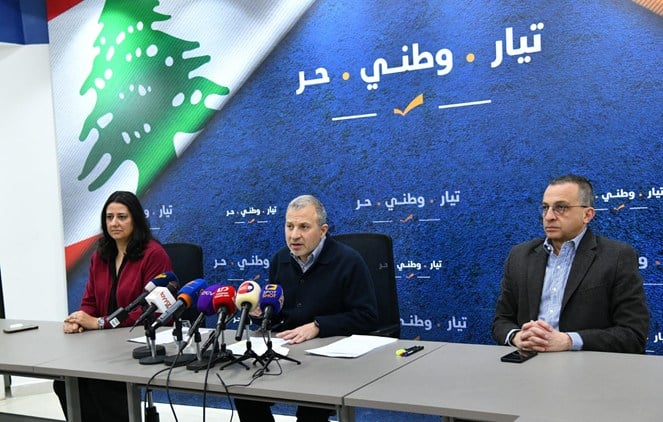
President of the Free Patriotic Movement (FPM), MP Gebran Bassil, said, during a press conference on the elections and the rights of Lebanese abroad, that preparations are underway for a series of legal and constitutional measures.
He added that all necessary legal and administrative steps will be taken, both locally and internationally.
Bassil noted that an appeal has been filed before the State Council (Shura Council) against the decision related to the submission of candidacies. He also said the government has been questioned about its failure to implement the law. In addition, a formal letter has been sent to Parliament, and a motion of no confidence has been signed by ten MPs against the Minister of Foreign Affairs and against the government.
He explained that three legislative sessions have passed, and there was also sufficient time to hold a session to question the government, something Parliament Speaker Nabih Berri had promised.
Bassil called on Lebanese abroad to mobilize. He urged anyone wishing to submit their candidacy from abroad to do so, stressing that this grants constitutional standing to challenge the decisions and the electoral process.
Bassil said they are “defending a basic principle in a state governed by law: respect for legislation and for the constitutional rights of Lebanese citizens wherever they are.”
He stressed that “this is not a technical or procedural matter,” but one that directly concerns three fundamental political rights guaranteed by the electoral law for expatriates: the right to vote, the right to run for office, and the right to direct parliamentary representation.
He stated that Lebanese abroad have the right to vote, to run for office, and to be represented wherever they choose, either in their district in Lebanon or in a district abroad.
He pointed out that the law established District 16, allocated six seats for expatriates, and raised the number of MPs to 134.
Bassil said the law is clear, easy to apply, and the right exists.
“Can an administration suspend a political right established by law?” he asked.
Bassil said there is a clear contradiction.
On one hand, Minister of Interior and Municipalities Ahmad Hajjar officially announced the election dates and called on expatriate voters to vote on May 3rd, 2026, and on residents in Lebanon to vote on May 10th, 2026.
This, he said, means the electoral law is already being applied with regard to voting abroad. On the other hand, a circular on deadlines for candidacy declarations and lists stated that opening nominations for the six expatriate seats is still not possible, due to the absence of the necessary legal and implementing texts.
Bassil said the risk lies in the phrase “to date” written in the Minister of Interior’s circular.
According to Bassil, this phrase admits that the issue is not legal, but administrative and political. The law exists, and the right exists, yet the administration is refusing to apply it. He insisted there is no need for new legislation, but rather to implement regulations or a joint decision by the Ministers of Interior and Foreign Affairs to define execution mechanisms.
These measures do not create the right or cancel it; they simply regulate how it is applied. Therefore, failing to issue additional texts and using that as a reason not to open nominations effectively shifts the problem from the law to the administration, because issuing implementing measures is the administration’s responsibility.
“Can an administrative failure be turned into a political reality that empties the law of its substance?” he asked.
Bassil said regulatory texts exist to apply the law, not to block it. He added that “to date” implies the obstacle is temporary. If it is temporary, he asked, what is it, and who is responsible?
He said that when the government won confidence, it knew an electoral deadline was coming within a year. He added that the Minister of Foreign Affairs is responsible for implementing the law, yet is deliberately refraining from signing and submitting the report.
Bassil also noted that in 2021, under Decision No. 1028, a joint committee was formed to study how to implement Chapter 11 of the electoral law. It produced a comprehensive report and offered clear options, without saying that implementation was impossible. This, he said, means the implementation basis has existed since 2021.
He added that a later joint committee was formed on October 23, 2025, but a political decision appeared to have been taken in advance, without waiting for its findings. He said that on October 29, 2025, the Cabinet decided to amend the electoral law and relied on the claim of “impossibility of implementation.” The new committee, made up largely of advisers to the Foreign Minister and mostly outside the diplomatic corps, also did not say implementation was impossible. Instead, it proposed four clear options for allocating the six seats.
One option was to adopt the recommendation of the earlier joint committee. This, he said, confirms that the debate was about how to implement the law, not whether it can be implemented. If four options exist, then implementation mechanisms exist, and the law is applicable. He argued that the option recommended by both committees should be adopted.
Bassil said parliamentary committee sessions, based on the testimony of relevant officials and even the Interior Minister, confirmed that the report is completed and solutions are available. He said the issue is not a legal vacuum. A report exists, options are ready, and an administrative process was intentionally left unfinished due to a political decision to obstruct.
He asked why the report was not presented to the Cabinet, and who was responsible for keeping it out of circulation. Bassil said they are obliged to take clear legal steps to protect a right guaranteed by law and the Constitution. He said the first step is to file a formal notice of dispute against the Ministry of Foreign Affairs.
He stressed this is not symbolic, but a key legal step to document an administrative failure, place the administration before its responsibilities, and give it a final chance to correct course and implement the law properly. He added that this notice moves the issue from political debate to legal accountability. It also confirms that the problem is not the legal text, but the refusal to implement it. He described it as the legal gateway for any later court challenge. It preserves the rights of those affected and safeguards legal deadlines.
Bassil said the notice relied on the Ministry of Interior’s own position, since it signaled readiness to apply the law and used the phrase “not possible… to date” in its circular.
He added that the Minister of Interior told parliamentary committees he was preparing a report and was ready to apply the law, provided the Ministry of Foreign Affairs agreed.
For Bassil, this shifts the question from “can it be implemented?” to “who is blocking implementation?”
He said the law guarantees three clear constitutional rights for expatriates, and that comparative legal practice treats such rights as acquired rights that cannot be rolled back.
Bassil stressed that an administration’s refusal to exercise its powers is not neutrality; it is, in itself, a legal violation, what administrative law describes as an unlawful failure to act.
He added that the government committed in its ministerial statement to issuing the implementing regulations needed to apply the laws.
Therefore, failing to issue these regulations breaches its institutional duty toward the program it pledged. He said they will not stop at this step. The formal notice is the beginning of the process, not the end. Bassil believed elections are not a minor administrative detail. They are a core constitutional obligation. Elections must be conducted under the full provisions of the law, not through partial or selective application.
He said what is needed is not new interpretations or political readings, but simply applying the law as enacted, because any rollback or obstruction of a guaranteed right undermines the legitimacy of the democratic process itself.
He also stressed that they should not hide behind the Legislation and Consultations Commission, since its opinion is not binding and does not override the law.
He pointed out that previous suspensions required explicit laws, including Law No. 67/2018 (April 2018) and another suspension in October 2021.
He said “to date” does not prevent legal challenges and does not replace implementing the law, especially since calling the electorate already set a voting date for expatriates.
He concluded by saying that 144,000 Lebanese abroad registered based on this law. They understood and accepted that they would vote from abroad for the six MPs who directly represent them in District 16.
He asked: What will you tell them today? And how will you remove their names from the voter rolls abroad to force them to vote inside Lebanon?
He added that the law states Parliament’s membership became 134. It cannot be reduced to 128, and six MPs cannot be removed without electing them, through an administrative decision by a minister or by the Legislation and Consultations Commission, without amending the law.
Bassil again urged the 144,000 registered expatriates, and others, to run for office so they do not lose their rights, asking: “Are we living in a state, or in a jungle?”
Bassil Announces Legal and Constitutional Steps to Protect Expatriates’ Rights